

Autocrats demonize the past of their countries, and prior leaders to justify their rule. The Castro brothers are not an exception. In the Cuban case, as time went on and the dictatorship worsened the history of Republican Cuba was increasingly demonized. Entire chapters of Cuban history were omitted, especially the pioneering international human rights legacy of the Cuban Republic.
To hold a meaningful evaluation of the current human rights situation in Cuba requires placing it into historic context.
Fidel Castro in a June 1986 interview in Havana with French journalist Patrice Barrat of Le Figaro Magazine distinguished “revolutionary liberty” (the kind he said Cuba practiced) from “bourgeois liberties” that originated in Europe, stating that the two concepts of freedom were different and that Cuba should not be judged by European standards. The 1987 documentary excerpted this part of the conversation and included it in the documentary Nobody Listened.
This ignores the active and early role Cuban diplomats and jurists played in the 1940s proposing the creation of a UN human rights body, an international declaration of human rights, and lobbying to place it on the agenda of the newly formed United Nations.
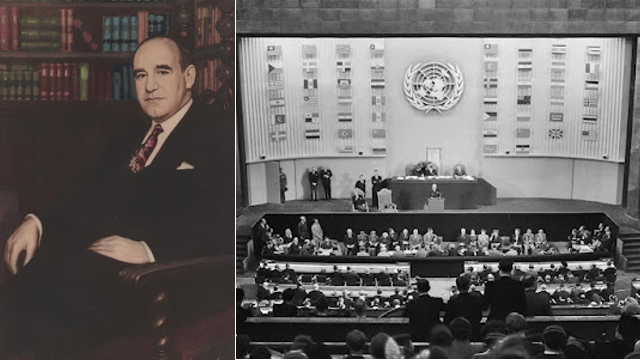
In February 1945, with World War Two still underway, at the Chapultapec Castle in Mexico City twenty Latin American countries and a large delegation from the United States participated in the Inter-American Conference on Problems of War and Peace. Dr. Gustavo Gutierrez attended the conference, and presented on behalf of Cuba “two detailed proposals for consideration, a Draft Declaration of the International Rights and Duties of the Individual and a “Draft Declaration on the Rights and Duties of Nations.”
On December 10, 2017 in the Miami Herald’s letters to the editor section, Pablo Pérez-Cisneros Barreto, the son of Guy Pérez-Cisneros y Bonnel, wrote of his family’s and Cuba’s legacy in drafting of the Universal Declaration of Human Rights.
My late father believed that the declaration is the fruit of the great efforts of our civilization and human progress, a unique moment in which humanity came of age in its civic education; that it is also a source of inspiration for the formation of today’s citizens, and not cause for divisions among them. […] Cuba had the distinction of being the country that proposed the finished declaration be put up for its final UN vote on Dec. 10, 1948. Hard to believe now but Cuba was once a leader when it came to human rights.
Havana has memory holed the history of Cuba’s leading role in proposing, drafting, and lobbying for the Universal Declaration of Human Rights between 1945 and 1948. The names of Guy Perez Cisneros, and Gustavo Gutierrez Sanchez who broke new ground on the international human rights front were minimized for decades, and this part of their legacy erased in Cuba.
Prior to 1959, Cuba had problems – an authoritarian dictatorship imposed on March 10, 1952 that was unwanted – however it did have numerous newspapers, radio and television stations that challenged the Batista regime along with a vibrant civil society that struggled and protested against the dictator.
Now with the arrival of the Castro regime in 1959 promising the restoration of democracy and the rule of law – the exact opposite was done. Mass executions broadcast and filmed to terrorize the population. Conservative estimates of the number of Cubans killed under Castroism at 73,000.
End of the free press
Independent newspaper editors first warned that their lives were at risk if they wrote critically against the regime and within a year and a couple of months all of the independent newspapers were shut down, on occasion by violent mobs organized by the dictatorship and replaced with regime publications subordinated to the communist party line.
Cuba’s longest running newspaper with the highest circulation with roots back to two newspapers: 1813 with El Lucero de la Habana (The Havana Star) and the Noticioso Mercantil (The Mercantile Seer) whose 1832 merger established El Noticioso y Lucero de la Habana, which in 1844 was renamed the Diario de la Marina.
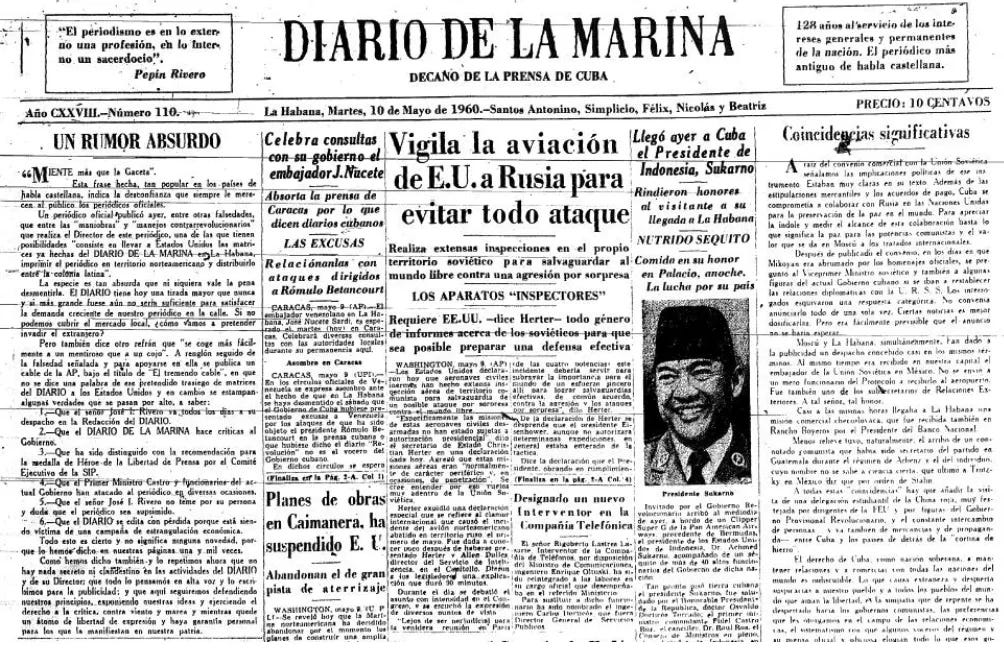
Over its long history La Marina kept faith with its readers that from 1902 to 1959 defended a democratic Cuba, while opposing the dictatorships of Gerardo Machado in the 1930s and Fulgencio Batista in the 1950s.
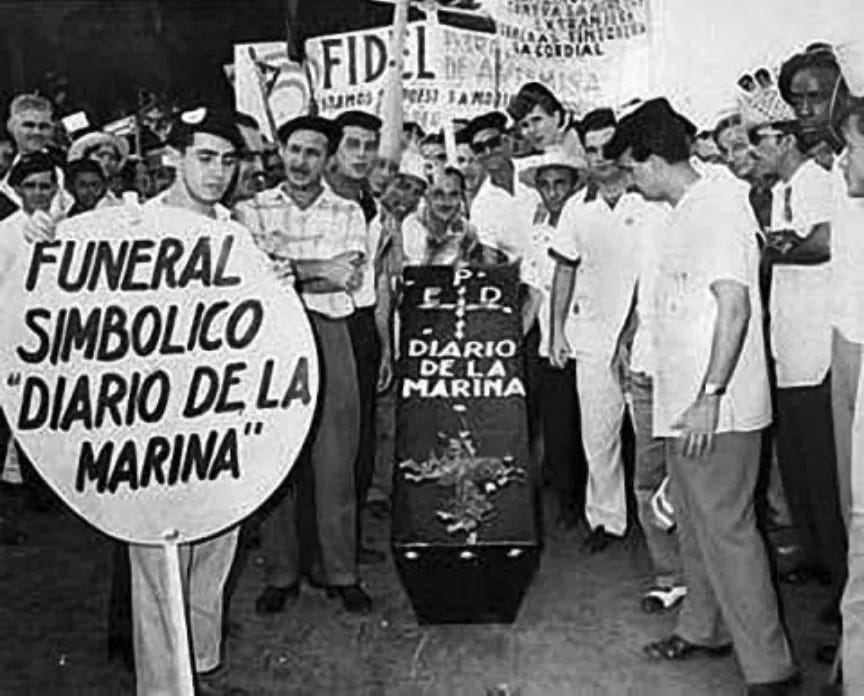
At the University of Havana, and the government controlled Federation of University Students, FEU, held a mock burial of the Diario de la Marina newspaper. [ Fidel Castro had intervened in the student elections against the popular leader Pedro Luis Boitel, because they did not like Boitel’s democratic convictions.]
On May 12, 1960—the Diario de la Marina newspaper was closed, ending its 128 year history. This was a day after José Ignacio Rivero took refuge in the Peruvian Embassy in Havana.José Ignacio Rivero was the last publisher of Cuba’s legendary Diario de la Marina from 1944 to 1960. It was a family paper handed down from father to son over three generations. José Ignacio was the son of Pepín Rivero (publisher from 1919-1944) and the grandson of its founder Nicolás Rivero.
Humberto Medrano, deputy editor of Prensa Libre, the newspaper with the largest circulation in Cuba, published a text the following day:
It is painful to witness the funeral of freedom of thought in a center dedicated to culture […] Because what was buried last night [at the University] was not a newspaper. Freedom of thought and expression were symbolically buried. The obligatory climax of that act has been the comment of the newspaper Revolution. The title of that comment says it all: “Free Press on the way to La Marina.” They didn’t have to say it. Everybody knows.
Prensa Libre was attacked by a mob then shut down days later on May 16, 1960. Prensa Libre‘s and La Marina’s offices and equipment were confiscated by the dictatorship and used to publish its dictatorship controlled newspapers.
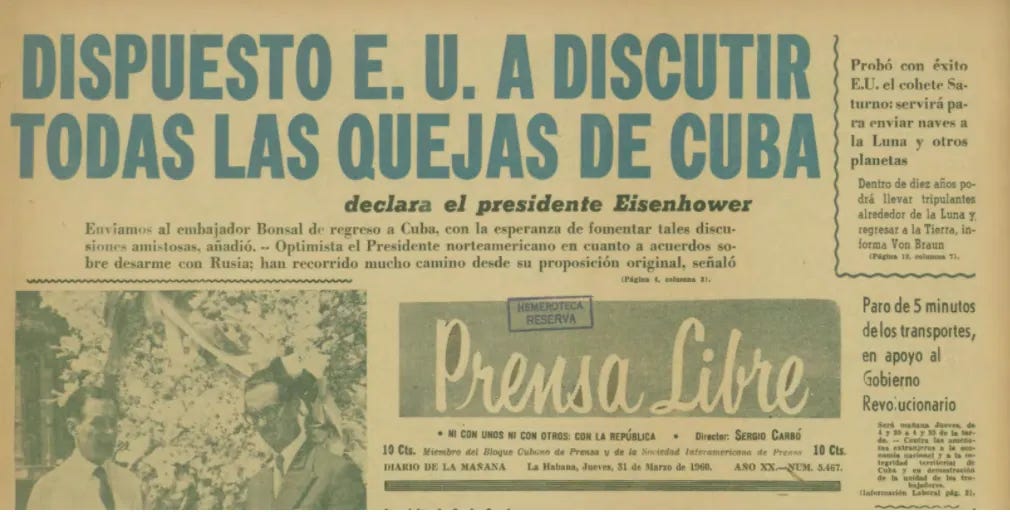
Humberto Medrano would also go into exile, but he would go on to become one of the founders of Radio Marti that broke through regime censorship beginning in the 1980s. It is important to recall that he was a vocal opponent of the Batista dictatorship. Medrano was arrested three times for his opposition to the Batista regime, and initially supported the Cuban revolution believing it would restore democracy.
The poet who became a prisoner of conscience
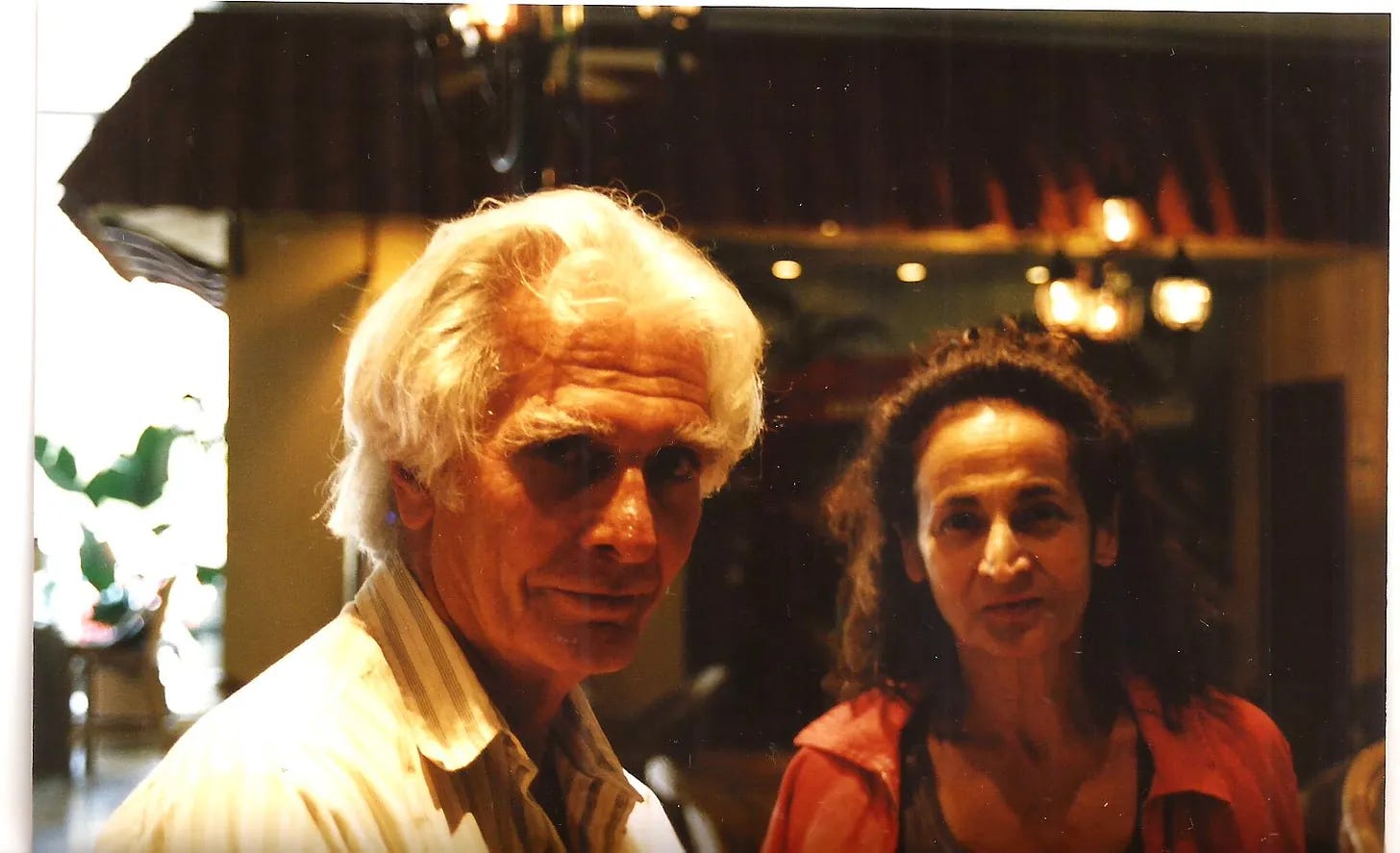
Jorge Valls fought against tyranny and barbarism his whole life and in Cuba that meant challenging the dictatorships of Fulgencio Batista and Fidel Castro. Cuban author Reinaldo Arenas described it as a heroic stand.
He suffered prison and exile during the Batista regime.
During the Castro regime he was arrested in 1964 and sentenced to 20 years in prison for testifying in defense of a friend who was being subjected to a show trial. He served 20 years and 40 days.
While in prison he organized teach-ins, taught some prisoners how to read and smuggled his poems out of prison.
Amnesty International recognized him as a prisoner of conscience.
Estimates for the number of political prisoners in Cuba in the early 1960s range from about 15,000–25,000 (based on later Cuban official admissions and some archival figures) to 60,000–100,000 (from contemporary exile, opposition, and some Western sources). No precise, independently verified official total exists because independent monitoring of the prisons, other than the International Committee of the Red Cross for a few months between 1988 and 1989, have been systematically barred.
‘Within the revolution, everything; outside of it, nothing.’
On June 30, 1961 Fidel Castro gave his speech to [Cuba’s] intellectuals where he summed up the limits of artistic expression: ‘Within the revolution, everything; outside of it, nothing,’ he told intellectuals and artists. Nearly a decade later on April 27, 1971 the case of Heberto Padilla underscored the limits of artistic expression in Cuba.
Heberto Juan Padilla, a Cuban poet, who like many had been an enthusiastic supporter of Fidel Castro ousting Cuban dictator Fulgencio Batista in 1959, became disillusioned when the Castro regime’s dictatorial nature became clear, and reflected it in his writings. In 1968, however, Cuban judges in the national poetry contest awarded their “Julian del Casal” poetry prize to Padilla’s collection, Fuera del Juego (Out of the Game), which contained critical lines such as:
“The poet! Kick him out!
He has no business here.
He doesn’t play the game.
He never gets excited
Or speaks out clearly.
He never even sees the miracles …”
The book was published but an addendum was added that criticized the work as counterrevolutionary, and Heberto Padilla was placed under house arrest. On March 20, 1971 Heberto Padilla and Belkis Cuza Malé’s home was raided by armed state security agents at seven in the morning and they were arbitrarily detained.
Belkis was held incommunicado for three days and released. Heberto was interrogated for over a month and psychologically tortured by the secret police and on April 27, 1971 taken to confess before the National Union of Writers and Artists of Cuba (Unión Nacional de Escritores y Artistas de Cuba, UNEAC) his counter-revolutionary tendencies. Cuban literary critic José Antonio Portuondo served as the moderator and introduced Heberto Padilla to the gathered group, and the numerous cameras of the official press.
Totalitarianism codified
Over time the totalitarian apparatus forged “laws” which justified the already existing practices of outlawing free speech both spoken and written. Written and Oral Enemy propaganda or assisting in the distribution of either would net you lengthy prison terms and are still on the books today.
This was formalized in 1976 in Cuba with a Soviet-style constitution that only recognized freedom of expression if it was “consistent with the purposes of socialist society”. It also mandated that all mass media be state-owned and prohibited. It warned that infractions of these principles were punishable. This was maintained in both the 1992, and 2019 successor constitutions.
“Enemy propaganda” was firmly institutionalized in the 1979 Penal Code. The specific crime of “disseminating enemy propaganda” became a primary legal instrument for repression in the late 1970s, with “Propaganda Against the Constitutional Order” reinforced in the draconian 2022 Penal Code
In the late 1990s the dictatorship passed Law 88, also known as the gag law, which threatened Cubans with 20 year prison sentences and the death penalty for speaking critically of the regime to an international media source, and supporting economic sanctions.
Cuba’s persecuted human rights movement persevered

In the 1987 documentary Nobody Listened, directed by Néstor Almendros and Jorge Ulla the world was introduced to Ricardo Bofill and the nonviolent human rights movement on the big screen. Dr. Bofill is interviewed and discusses his circumstances as a dissident in Cuba engaged in the battle of ideas:
“I can’t understand the hatred towards me. Because, really in the only field I’ve done battle, is the field of ideas. In this field I’ve had no response just prison and the police. And I don’t know why because the revolution controls all mass media. They have editorials, journalists, even many writers in the world. I don’t know why the response, time and again, has been jail. The response should come in the field I fight in, with ideas. I was arrested again in 1983. On that occasion, I was sentenced to 17 years in jail accused of activities in the Cuban Committee for Human Rights and the last period of prison began. For reasons of health and others I know not of in 1985 I was placed in the status I’m now in which is “conditional liberty with restriction of movement.”
Fidel Castro was asked the name of the human rights defender in another interview. The Cuban dictator dismisses his importance, but it is obvious in the context of his answer that he knows very well who this lone activist is, and views him as a threat.
In an open letter written in 1986 Dr. Bofill rejected regime slanders and staked out their position as a movement: “We have nothing to do with the CIA, we do not participate in violent acts, we have no other weapon than the word, and we are going to use it while we have a breath of life left.”
In 1988 he was forced out of the country by the dictatorship, but continued his human rights work from exile in Miami, while Gustavo Arcos remained and continued to do the work in Cuba.
The Cuban Committee for Human Rights
This movement was founded by a handful of activists on January 28, 1976 that today is a nationwide movement of thousands who are nonviolently engaged in the battle of ideas and the defense of human rights. Today’s repression across the island continues to demonstrate that the Castro regime is terrified of what Ricardo Bofill started.
In 1982 at the Combinado de Este prison Gustavo Arcos Bergnes and his younger brother, Sebastián Arcos Bergnes, joined the Cuban Committee for Human Rights. The brothers had been imprisoned in 1981 for trying to leave the country illegally. Soon thereafter, the Committee began to send out proclamations denouncing the deplorable conditions in which political prisoners were kept.
Shortly after his release from prison in 1988, Gustavo Arcos succeeded the committee’s executive director, Dr. Ricardo Bofill, who was forced into exile.
In 1990, against the protests of many Cuban exiles, Gustavo Arcos issued a statement to Castro asking him to convene a “National Dialogue,” which would include all segments of Cuban society, on the island and in exile. During his address to the Worker’s Congress on January 28, 1990, Castro issued his response noting that “the Cuban people” will take care of those activists.
On March 5, 1990 government sponsored mobs attacked Sebastian Arcos’s home. On March 8 another mob, led by future Foreign Minister Roberto Robaina, attacked Gustavo’s home. From exile, many old friends asked Gustavo to dissolve the Committee to save the activists’ lives. Gustavo replied: “The Cuban Committee for Human Rights will continue its work, even if it costs us our own lives...no terror, nor propaganda will be able to deter the development of humanistic ideas in our country.”
On January 13, 1992 the executive board of the Cuban Committee for Human Rights again issued a statement reaffirming their commitment to nonviolence and calling for dialogue: “Violence is not and cannot be the solution to our problems... We will not tire from insisting that the only possible solution is civilized discussion of our differences. This is an appeal to Cubans for wisdom and common sense... No act of violence is justified... Let us say no to violence and learn to live in peace.”
Gustavo Arcos Bergnes, Sebastián Arcos Bergnes and Jesús Yanes Pelletier were arrested at their homes in Havana on the evening of 15 January 1992. Both Gustavo and Yanes Pelletier were released after approximately 24 hours. However, Sebastian Arcos Bergnes was charged with “enemy propaganda” and “inciting rebellion,” he was sentenced to four years and eight months in jail. He was transferred to Ariza Prison in Cienfuegos Province, more than 130 miles from Havana, where Sebastian was imprisoned alongside dangerous criminals and was systematically denied medical attention. In 1993 the regime offered him a deal: Sebastian would be released immediately if he only agreed to leave the island for good. Sebastian rejected the deal, becoming the first documented case of a political prisoner choosing prison in Cuba over freedom in exile.
After an international campaign that included his designation as an Amnesty International prisoner of conscience and a request by France Libertés, the organization founded by former French first lady Danielle Mitterrand, Sebastian Arcos was released in 1995. A few weeks after his release, Arcos was diagnosed with a malignant tumor in the rectum, for which he had previously been denied medical care in prison. After a Cuban doctor was fired from his post for treating Arcos, he traveled to Miami for further care.
In 1996, Sebastian Arcos Bergnes testified before the UN Human Rights Commission in Geneva, Switzerland. Sebastian Arcos Bergnes died in Miami surrounded by relatives on December 22, 1997.
Due to his worsening health in his last years Gustavo Arcos lowered his profile and ceded much of the work to exiled members of the Cuban Committee for Human Rights. Nevertheless, he met with US Senators visiting Cuba in 2000, with former President Carter in 2002 and signed a letter in 2003 denouncing the unjust imprisonment of 75 Cuban dissidents imprisoned in the Black Cuban Spring.
In the 2005, Associated Press article, Anita Snow reported that he stayed in touch with other dissidents and spoke “frequently with Oswaldo Paya, a devout fellow Roman Catholic who led a signature-gathering effort called the Varela Project, which sought a referendum asking voters if they favored civil liberties such as freedom of speech and the right to business ownership.” The article concluded with Gustavo’s concern that he would not live to see the return of democracy saying : “I do hope I will see the end of this, but I’m not sure if I will.
Gustavo Arcos passed away in Cuba on August 6, 2006. Martha Frayde passed away in Spain on December 4, 2013. Ricardo Bofill remains in exile in Miami, Florida and an active member of the Cuban Committee for Human Rights.
Breaking their own laws: Crackdown on Project Varela
In 2002, students at the University of Camaguey were expelled for signing the Varela Project, a citizen initiative aimed at reforming Cuba’s communist constitution to restore respect for human rights using existing legal means in the existing constitution rolled over from the 1940 constitution. Among those students punished were Roger Rubio Lima and Harold Cepero Escalante.
Over 30,000 Cubans would eventually sign the petition, and organizers in 2003 were subjected to arrest, show trials, and long prison terms.
A decade later, on July 22, 2012, Harold Cepero and Oswaldo Paya Sardiñas, leaders of the Christian Liberation Movement, were killed in a car crash orchestrated by state security agents. The Inter-American Commission on Human Rights concluded that the Cuban regime is responsible for their deaths in a report published on June 9, 2023.
The war on artists continue
Decree 349, which was implemented by Havana on December 7, 2018, mandated that everybody involved in artistic endeavors be assessed and registered by official agencies. In essence, this would make it unlawful for artists to work without a registration, giving the Cuban dictatorship a new and more effective way to stifle opposition and regulate artistic expression.
Cuban artists and prisoners of conscience Luis Manuel Otero Alcántara and Maykel “Osorbo” Castillo Pérez were sentenced to five and nine years in prison respectively by the Castro regime on June 24, 2022. Political trials have unjustly jailed hundreds of innocent Cubans, including these two artists.
Luis Manuel served out his full sentence, was held incommunicado, until he was forcibly exiled a short time later. Maykel has served over five years of his nine year prison sentence.
Both are members of the San Isidro Movement, founded in Havana, Cuba in 2018 to defend artistic freedom. Both appeared in the Patria y Vida video that went viral in Cuba, and around the world.
Maykel “Osorbo” Castillo Pérez was one of the co-authors of the song, and won together with the other musicians two Latin Grammys in 2021.
Maykel has been arbitrarily detained since May 18, 2021. Luis Manuel Otero Alcántara was unjustly jailed for five years beginning on July 11, 2021 when the political police detained him to prevent him participating in the 11J protests.
Neither Cuban artist should have ever been imprisoned, and both have been recognized as prisoners of conscience by Amnesty International. These are not just trials, but part of a terror campaign by the Cuban government to silence dissent in Cuba.
The trials continue
Thirteen Cubans in a trial held in January 2024, in two 12 hour sessions, received prison sentences ranging from 4 to 15 years for nonviolently protesting in the streets. Only two relatives per detainee were able to access the interior of the room, according to eyewitnesses present.
Mayelín Rodríguez Prado (age 23), received the longest sentence of 15 years, accused of “continued enemy propaganda” and “sedition.” She was the one who streamed live the popular protests that occurred in Nuevitas and recorded how government agents beat two eleven-year-old girls. Mayelín was jailed at age 21, and separated from her toddler.
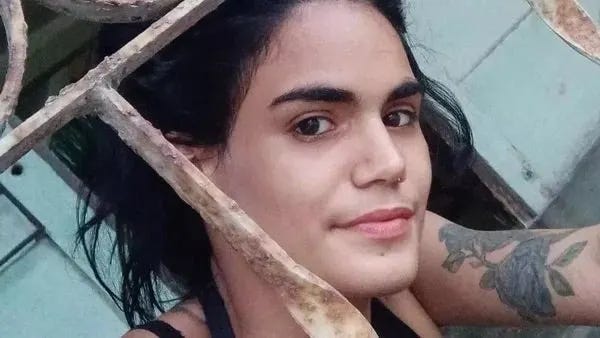
Amnesty International’s 2026 country report offered the following description of the situation on the ground for human rights defenders, pro-democracy activists, and artists.
“The systematic policy of repression against activists and members of the political opposition continued. Human rights defenders saw their rights restricted, and their work continued to be stigmatized and criminalized. Activists, members of the opposition, artists, intellectuals, university students and human rights defenders faced threats, harassment, digital abuse and unlawful interrogation and surveillance.”
There are over 1,300 identified political prisoners in Cuba today. The International Committee of the Red Cross was last able to inspect Cuba’s prisons in 1989. Meanwhile at the prison at the US Guantanamo Naval base there have been over 100 inspection visits since 2002.
Cuba once helped write the world’s human-rights charter. The Castro dictatorship has spent more than six decades trying to bury that legacy—and the Cubans who still defend it.
Spot on as always. An add: minors, including one reported to be just 14, are imprisoned in Cuba for participating in peaceful demonstrations demanding freedom.