

December 10, 2025 marks the observance of international human rights day. This past week both domestically and internationally Havana continued to play a negative role on the human rights front.
Prisoners Defenders, the Spain based NGO, today lists 1,192 political prisoners in Cuba. Human rights defenders, musicians, and artists are found among them. One of them just celebrated his fourth birthday unjustly imprisoned.
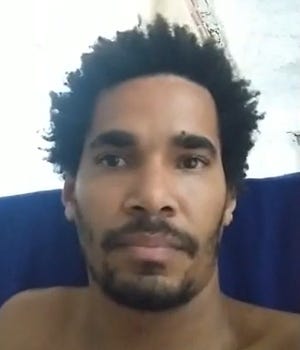
Cuban prisoner of conscience and artist turned 38 in prison on December 2nd, and initiated 10 day 12 hour fast to protest his unjust imprisonment.
Luis Manuel Otero Alcántara, who turned 38 years old in Guanajay Prison outside Havana on December 2nd, initiated a fast to protest the injustice of his imprisonment and that of the other political prisoners in Cuba. The fast is being conducted every day from 6 am to 6 pm until tomorrow December 12th.
Jostein Hole Kobbeltvedt, Executive Director of the Rafto Foundation for Human Rights spoke out in solidarity with the Cuban artivist, “Luis Manuel Otero Alcántara is imprisoned for standing up for the basic right to freedom of speech through art. We call for the immediate release of him, and all other political prisoners in Cuba.”
On December 3, 2025 Artists at Risk Connection expressed its grave concern for Cuban artist and activist Luis Manuel Otero Alcántara, urging Cuban authorities to immediately release Luis Manuel and all other unjustly detained artists and prisoners of conscience in Cuba.
The Center for a Free Cuba has sought to remind Cubans on International Human Rights Day of their legacy in the drafting and passage of the Universal Declaration of Human Rights.
Recovering Cuba’s human rights legacy
On International Human Rights Day in 2022, the Center for a Free Cuba hosted a virtual meeting with three generations of Cuban human rights defenders to observe Cuba’s human rights legacy, and how to recover it.
The Cuban dictatorship rejects the fundamentals of the Universal Declaration of Human Rights along ideological grounds.
One of the great lies of the Castro regime, and there are many, is the claim that the Universal Declaration of Human Rights contains rights that are alien to Cubans.
Fidel Castro in a 1986 interview claimed that “[y]our political concepts of liberty, equality, justice are very different from ours. You try to measure a country like Cuba with European ideas. And we do not resign ourselves to or accept being measured by those standards.”
The Cuban government has actively sought to undermine international human rights standards working in concert with other human rights violators.
This is why the Center continues to gather signatures advocating for the expulsion of Cuba from the UN Human Rights Council.
It is also why we seek to remind Cubans and non-Cubans of the role played by a democratic Cuba in the promotion of international human rights after WW2.
On December 10, 2022 Rosa Leonor Whitmarsh y Dueñas took part in a conversation with Carolina Barrero, and Yoel Suárez on “Recovering Cuba’s human rights legacy“. She gave an important message for this and future generations. Below is an excerpt from her presentation.
Rosa Leonor represents the Cuban Republic, demonized by Cuba’s communist dictatorship, that for fifty years saw Cuba progress on the political, economic, and international front.
She was born in Havana, Cuba on May 9, 1930. Rosa Leonor earned a Doctorate in Philosophy and Letters and dedicated her life as a pedagogue in Cuba, Mexico and the United States at all levels of education. She was a lecturer, essayist, and scholar of history.
Rosa Leonor taught at Vassar College, University of Anahuac, Tarbut Hebrew School in Mexico, Miami Dade College, Miami Dade Public School System as well as in private academic institutions. She was a founding member of the Centre for Human Rights of the Christian Democratic Movement of the Mexican delegation in Exile. Organizer of the Christian Democratic Training Seminars (1960-1970) that included the Social Christian Doctrine.
Rosa was also the great-granddaughter of Cuban independence general Calixto Garcia Iñiguez. Calixto Garcia beginning at age 18, fought in the 10 Years’ War (1868-1878), the Little War (1878) and the Cuban War of Independence (1895-1898). He fought in all the insurrections against Spanish colonial rule in Cuba over thirty years becoming a general, before succumbing to pneumonia while on a diplomatic mission to Washington DC on December 11, 1898. Like her great grandfather Rosa Leonor was steadfast in her opposition to the Castro regime, but hers was a non-violent struggle in the realm of culture, history, and education.
On the eve of the centennial of the Cuban Republic, Rosa Leonor Whitmarsh, then a professor at Miami-Dade Community College, who was part of the committee organizing events for the anniversary on May 20, 2002, observed, “The weekend will be bittersweet” … ”The history of Cuba is also the history of families,” … “It’s something you can’t let die.”
This Cuban woman of letters passed away on October 18, 2023.
She was part of the democratic tradition in Cuba that helped draft the Universal Declaration of Human Rights 77 years ago.
Carlos Prío Socarrás, Cuba’s last democratic president, was elected in free and fair elections and took office on October 10, 1948. President Prío valued human rights, as seen by the activities of his diplomats during the United Nations’ founding,but the path to the UN Human Rights Declaration in 1948 to the Varela Project in 2002 began much earlier.
It is also important to remember important men, and women who made a positive contribution to Cuba’s history.
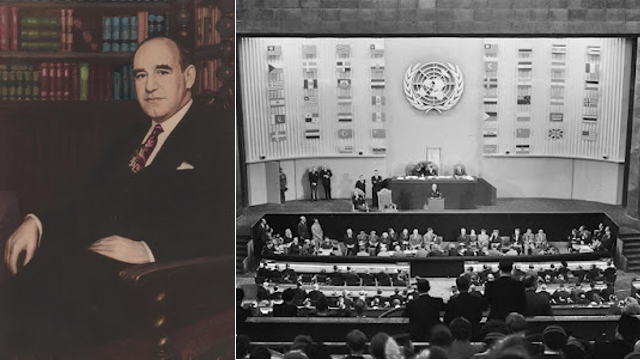
One of them was Gustavo Gutiérrez Sánchez, who you’ve never heard of, he has been called the “forgotten man.” who throughout his career, as a diplomat, lawyer, and scholar made positive contributions to both Cuba, and the international community.
Gutiérrez Sánchez drafted, and the Cuban delegation presented in 1947, during the Inter-American Conference on Problems of War and Peace held in San Francisco, two drafts that were included in the foundational document of the community of nations. He was not only an architect of the Universal Declaration of Human Rights but also of the 1940 Cuban Constitution, and Article 88g of the 1992 Cuban Constitution, which made the Varela Project possible, was largely the result of his work, although few today remember or acknowledge him.
Gustavo had been part of the Bicameral Commission that drafted the 1940 Cuban Constitution. One of its clauses, drafted years earlier by him, became “Article 135, Section F, stipulating that laws could be proposed by congressmen and senators, government officials, courts, and by citizens. In this case,” the Constitution states, “it shall be an indispensable condition that the initiative be exercised by at least ten thousand citizens who have the same status as voters.”
Cuba, Panama, and Chile were the first three countries to submit full drafts of human rights charters. Latin American delegations, especially Mexico, Cuba, and Chile inserted language about the right to justice into the Universal Declaration of Human Rights, in what would become Article 8.
Cuban delegate Guy Pérez-Cisneros addressed the UN General Assembly on December 10, 1948 proposing to vote for the Universal Declaration of Human Rights. The Cuban Ambassador celebrated that it condemned racism and sexism, and addressed the importance of the rule of law:
“My delegation had the honor of inspiring the final text, which finds it essential that the rights of man be protected by the rule of law, so that man will not be compelled to exercise the extreme recourse of rebellion against tyranny and oppression.”
Fulgencio Batista overthrew this democratic Cuba on March 10, 1952, Guy Pérez-Cisneros died of a stroke in 1953, and hopes for democratic restoration were dashed by the Castro brothers in 1959 when they imposed a communist dictatorship.
Summary executions, extrajudicial killings, and Cubans disappeared in large numbers followed.
A partial accounting of the disappeared in Cuba
Florida International University professor Daniel I. Pedreira, former Center for a Free Cuba program officer, presented his book “The disappeared under Castroism since 1959” on December 5, 2025 at Books and Books in Coral Gables.
His full presentation is available online on YouTube.
Cuban based human rights organization reports 150 inmates have died since January 2024 under conditions that violate UN Standard Minimum Rules for the Treatment of Prisoners at the Boniato Maximum Security Prison in Eastern Cuba
A disturbing report released on December 2, 2025 on the malnutrition crisis among prisoners at the Maximum Security Prison of Boniato details how inmates are subjected to extermination-level conditions and measures that violate their right to life. The report focuses on this prison, considered one of the most brutal on the island. It is located in Santiago de Cuba Province in Eastern Cuba.
“This prison holds around 2,000 inmates, 90% of whom are malnourished due to the famine imposed by government authorities. The lack of food is so severe that the government has been forced to establish a classification system in three cell blocks: dystrophic grade 1, grade 2, and grade 3. These cell blocks house around 90 prisoners each. However, the critically skeletal dystrophic inmates number around 1,000—half the prison population. Grade 3 dystrophics are walking skeletons, slowly dying, with two or three deaths reported each week,” states the report from the Council of Human Rights Rapporteurs, led by blind attorney and prominent human rights defender Juan Carlos González Leiva from the city of Ciego de Ávila.
Dystrophic is defined as the progressive degeneration of cells/tissues due to faulty nutrition.
According to the report, 70 inmates at the Boniato prison died in 2024 from malnutrition and other related illnesses.
So far in 2025, another 80 deaths have occurred due to lack of food, medical care, and unsanitary conditions.
The classification system used by Boniato prison authorities allows for an extra spoonful of the prison’s poor-quality food to be given to dystrophic prisoners: “a sugarless herbal tea and a small piece of bread for breakfast; 3 or 4 spoonfuls of poorly cooked rice, a bit of broth without substance, and as a main course, one spoonful of colored wheat flour paste, repeated in the afternoon.”
“That’s why many prisoners survive only with what their families are able to bring them—families who themselves live in extreme economic hardship. But even this relief is often blocked by the authorities, who restrict both the amount and the type of food allowed,” the report adds.
Over the past two years, numerous reports of prisoner deaths in Boniato Prison—and under the control of its prison authorities—have come to light, demonstrating not only the responsibility of Havana but also confirming the systematic violation of the United Nations Standard Minimum Rules for the Treatment of Prisoners, which the Cuban State has signed.
The report further clarifies that this situation is not unique to Boniato Prison but is widespread across most Cuban prisons, due to the repressive and inhumane model being followed, and the lack of international inspections.
Democracies of the world and international human rights organizations need to denounce the horrific reality faced by both political and common prisoners in Cuba, and to demand that the Cuban government grant access to the International Committee of the Red Cross to enter Cuban prisons—access that has been denied since 1989.
Amnesty International released a report on how the Cuban government is “engaged in institutional gender-based violence against women human rights defenders, journalists, and activists”
Amnesty International on November 25, 2025 launched its new report “They Want Us Silent, But We Keep Resisting: Authoritarian Practices and State Violence Against Women in Cuba.”
Amnesty calls on “the Cuban authorities to end authoritarian practices and state gender-based violence against women human rights defenders. The report reveals that the Cuban state has implemented a systematic pattern of repression targeting women engaged in activism, journalism, and human rights defence. Such practices include arbitrary detention, unlawful surveillance, unjust criminalisation, enforced disappearance, and other forms of institutional violence — all within an environment marked by impunity for human rights violations and a lack of judicial safeguards.”
Please sign the petition calling on Havana to end the targeted repression of women human rights defenders
In response to these findings, Amnesty International on November 25, 2025 launched a global petition inviting people worldwide to urge President Miguel Díaz-Canel and the Cuban authorities to end the harassment and urgently adopt a comprehensive law on gender-based violence.
Cuban government, one of 12 in the World that voted against the return of Ukrainian children kidnapped in Vladimir Putin’s illegal war.
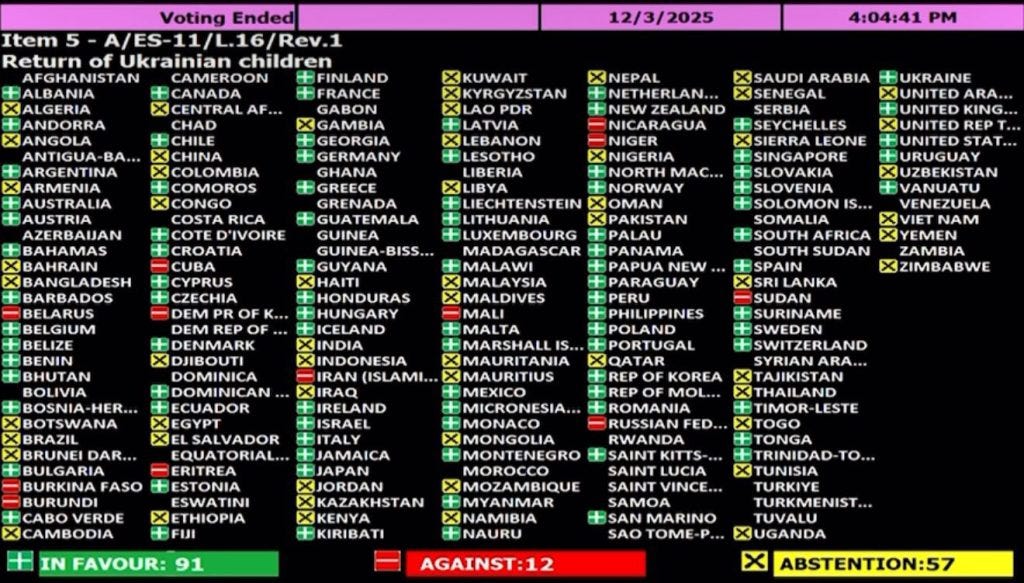
On December 3, 2025 the United Nations General Assembly voted 91 in favor, 12 against with 57 abstentions that: the Ukrainian children deported by Russia must be returned. The Cuban government was one of the 12 votes against the resolution. The dirty dozen were called out by the First Deputy Foreign Minister of the Ukrainian government.
Havana is also playing a negative role in Venezuela, conspiring with Nicolas Maduro against the sovereignty of the Venezuelan people who voted him out of office in a national election on July 28, 2024. What has followed is political violence, repression, and an increased Cuban presence to frustrate a democratic transition. Havana is also apparently in communication with Washington on the subject, and not playing a positive role. Past time for Havana to get out, and stay out of Venezuela.