

Milan Kundera, the Czech writer, in his 1999 novel The Book of Laughter and Forgetting observed that “the struggle of man against power is the struggle of memory against forgetting.” Memory provides context to unfolding events today, and helps to render informed judgements.
Over the next few hours and days the military dictatorship in Havana will spend large amounts of political capital at the United Nations in New York City to obtain a non-binding resolution condemning the U.S. embargo on Cuba.
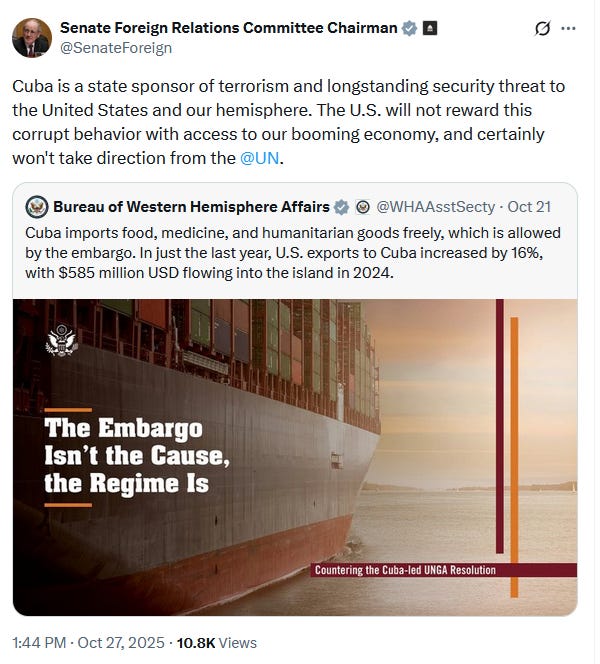
The U.S. Senate Foreign Relations Chairman tweeted out that “Cuba is a state sponsor of terrorism and [a] longstanding security threat to the United States and our hemisphere. The U.S. will not reward this corrupt behavior with access to our booming economy, and certainly won’t take direction from the UN.”
Havana should not be given this vote by democracies to legitimize this regime. This CubaBrief seeks to recall past events the regime in Havana would prefer forgotten, and others ongoing that today threaten European security.
Havana is a violent criminal organization masquerading as a government
The Cuban government is a communist dictatorship that has killed tens of thousands of Cubans, created a police state terrorizing millions more, driving millions into exile. Havana for over six decades has sponsored international terrorism on several continents and created terrorist groups still operating today. Fidel and Raul Castro along with thousands of their soldiers went to Ethiopia to assist war criminal Mengistu Haile Mariam consolidate power and commit genocide beginning in the 1970s and through the 1980s. Today, thousands of Cuban soldiers are in Ukraine assisting war criminal Vladimir Putin in the latest phase of his illegal war which began on February 24, 2022. “In many respects, Cuba can be accurately characterized as a violent criminal organization masquerading as a government,” former Defense Intelligence Agency Officer Christopher Simmons testified to Congress in 2012.
Consequences of legitimizing the regime in Havana
The failure of the international community to isolate Havana economically and politically led to its undermining democracies in Latin America, their greatest prize was turning Venezuela into a colony where thousands of Cuban soldiers, and spies continue to torture, rape, and kill Venezuelan dissidents. Before Hugo Chavez and Nicolas Maduro bailed out Havana, European, Canadian and Latin American investors helped fund Castroism, after the collapse of the Soviet Union in 1991, and kept it afloat. This complicity with a dictatorship oppressing Cubans, and in the case of Latin America that led to the destabilization of democracy in the region. This has continued to the present, and today threatens Europe directly.
Cubans stood and are standing up for freedom, and draconian measures are used against them by Havana
Notwithstanding the lack of solidarity, on July 11, 2021 protests began in San Antonio de los Baños, just South of Havana, and spread across Cuba in over 50 cities and towns with Cubans demanding freedom. President Miguel Diaz Canel, handpicked by Raul Castro, called for violence in a nationally televised address: “They [protesters] would have to pass over our dead bodies if they want to confront the revolution, and we are willing to resort to anything.” Protests in Cuba are common. Nationwide mass protests involving tens of thousands are rare due to the lack of communication, regime surveillance and repression that shutdown planning for large-scale protests.
Europe has been complicit in providing weapons to Cuban oppressors that are used on the Cuban people
The Spanish government in 2020 sold $1.4 million in weapons to the Castro regime. These included “revolvers and automatic pistols, automatic weapons with a caliber of 12.7mm” that included “rifles, revolvers, pistols, machine guns, silencers, chargers for these weapons, and optical sights.” These kinds of weapons are used against Cuban protesters. Madrid continues to sell ammunition to the dictatorship in Havana.
For example during the July 2021 protests video emerged of regime agents firing shots at unarmed protesters, in addition to the brutal beatings, violent house to house searches,and mass arrests. Today there are over 1,000 identified political prisoners in Cuba, most imprisoned during those protests.
International terrorism sponsor
Madrid ignores the role Havana played in providing logistical support, and training to Euskadi Ta Askatasuna (ETA), the Basque terrorist group that carried out terror attacks in Spain over a forty year period killing hundreds of Spaniards. It is not an overstatement to say that the ruling clique in Havana are experts in violence and terror. Spaniards are not the only victims. Havana has backed terrorist groups around the world carrying out kinetic actions in Latin America, Europe, the United States, and elsewhere.
On July 10, 1975, France expelled three high-ranking Cuban diplomats who according to the French Interior Ministry, were ‘constant visitors’ to the Paris hideout of the Venezuelan terrorist Carlos the Jackal. The same Carlos who had attended the Tricontinental, an international gathering of terrorists and guerillas in Cuba in January of 1966, with his father, then went to Camp Matanzas, a guerrilla warfare school run by Cuba’s general directorate of intelligence.
Despite normal trading relations and good diplomatic relations, Canadian diplomats, like their American counterparts, were also victims of the Havana Syndrome beginning in 2016.
Thirty years of Fidel Castro claiming U.S sanctions were unimportant
Havana claims that the U.S. economic embargo on Cuba over the past sixty six years has cost the Cuban dictatorship $1.499 trillion, but that was not what the regime, and their maximum leader, said during the first 30 years of the Cuban dictatorship. Here are some of the statements made by Fidel Castro between the 1964 through 2000 related to the economic embargo.
“We are going to have, within ten years, a milk production higher than the Netherlands and a cheese production higher than France. That is the great goal that we propose to achieve. By that date we think that the amount of 30 million liters of milk will be exceeded. So there will be to export … you can imagine.” said Fidel Castro, in an interview with Eddy Martin from the official Hoy newspaper on March 2, 1964.
“The great battle of the eggs has been won. From now on the people will be able to have sixty million eggs each month,” said Fidel Castro in a speech on January 2, 1965.
“In 1970 the Island will have 5,000 experts in the cattle industry and around 8 million cows and calves that will be good milk producers” …. “There will be so much milk that the Bay of Havana will be able to be filled with milk,” said Fidel Castro in his December 1966 speech during the Assembly of the Federation of Cuban Women, a mass organization of the dictatorship.
Fidel Castro, speaking at the First Congress of the Communist Party of Cuba in December 1975 bragged about the unimportance of economic sanctions saying,“at first (the United States) their cancellations were quite annoying … but when luckily, we did not depend on them for anything, neither in trade, nor in supplies, nor in anything. If we are already victorious now, after victory, what can they threaten us with? With canceling what … what? ”
“The United States has less and less to offer Cuba. If we could export our products to the United States, we would have to start making plans for new production lines … because everything that we produce now and everything that we are going to produce in the next five years has already been sold to other markets. We should deprive other socialist countries of these products in order to sell them to the United States. But the socialist countries pay us much better prices and have much better relations with us than we have with the United States. There is a popular saying that goes: ‘Don’t trade a cow for a goat.’” said Fidel Castro in his interview with Playboy published in April 1985
“Cuba will not buy an aspirin or a grain of rice. They have put a lot of restrictions (on the permission to sell food and medicine) that make it humiliating for the country, but also make it impossible in practice,” said Fidel Castro, in front of the United States Interests Office, in Havana, Cuba on October 18, 2000.
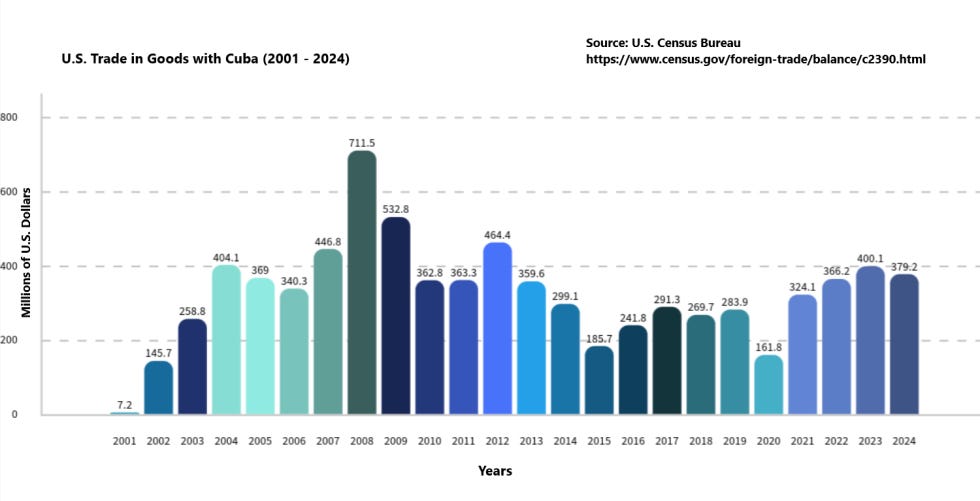
The Castro regime would go on to purchase billions in American agricultural products between 2000 and the present, but to do so they defaulted on what they owed to others. The peak year of trade between Cuba and the United States was in 2008, the last full year of the George W. Bush Administration. Press accounts of the U.S. Embargo on Cuba do not mention how it saved American taxpayers from billions in bad debt by the Cuban government. Nor do they discuss the circumstances that drove the United States to impose an embargo on the Castro regime.
How the U.S. embargo on Cuba came to be first imposed.
U.S. policy towards Cuba has not been static since January 1, 1959 but has been changing and driven by various interests, including U.S. national interests. There is a lot of disinformation about how the U.S. Embargo was first imposed on Cuba, and how and why the U.S. broke diplomatic relations with Havana. Here is a brief breakdown of what happened between January 1, 1959 and January 3, 1961.
Fidel Castro overthrew the Fulgencio Batista regime on January 1, 1959 following a U.S. arms embargo being imposed on the military dictator in the spring of 1958. The United States had actively pressured Batista to leave office since 1958. On January 7, 1959 the United States recognized the new Cuban government ushered in by the Castro brothers. It took just seven days to recognize the new regime.
In comparison it had taken the United States 17 days to recognize the government of Fulgencio Batista following his March 10, 1952 coup. The United States had not been consulted ahead of time about Batista’s plans and this led to the delay in recognition.
In April 1959 Fidel Castro visited the United States on an eleven day trip that concluded with a three hour meeting with Vice President Richard Nixon on April 19, 1959.
Within three months of U.S. recognition of the revolutionary government in Cuba the new regime began targeting American interests on the island and allying itself with the Soviet Union, the People’s Republic of China, and plotting the overthrow of several Latin American governments. It is important to revisit why the embargo was first imposed, and why it remains relevant today.
Fidel Castro visits Caracas on January 23, 1959 and meets with Venezuelan President Romulo Betancourt, a social democrat, “to enlist cooperation and financial backing for ‘the master plan against the gringos.’”
On March 3, 1959 the Castro regime expropriates properties belonging to the International Telephone and Telegraph Company, and took over its affiliate, the Cuban Telephone Company.
On May 17, 1959 the government expropriated farm lands over 1,000 acres and banned land ownership by foreigners.
Havana beginning in 1959 sent armed expeditions to Panama, Haiti, Nicaragua, Venezuela and the Dominican Republic to overthrow their governments.
On February 6, 1960 talks began publicly between the U.S.S.R and Fidel Castro. The Soviet Union agreed to buy five million tons of sugar over five years. They also agreed to support Cuba with oil, grain, and credit.
On July 6, 1960 the Castro regime passed a nationalization law authorizing nationalization of U.S.- owned property through expropriation. Texaco, Esso, and Shell oil refineries were taken.
In September 1960 the Cuban government diplomatically recognized the People’s Republic of China.
The Eisenhower State Department in response to the above actions imposed the first trade embargo on Cuba on October 19, 1960, and it “covered all U.S. exports to Cuba except for medicine and some foods.” This did not alter Havana’s behavior.
On November 19, 1960 Ernesto “Che” Guevara heading a Cuban delegation in Beijing met with Mao Zedong between 4:20pm and 6:30pm and discussed revolutionary objectives in Latin America.
The last straw: When the limit was reached, and diplomatic relations severed
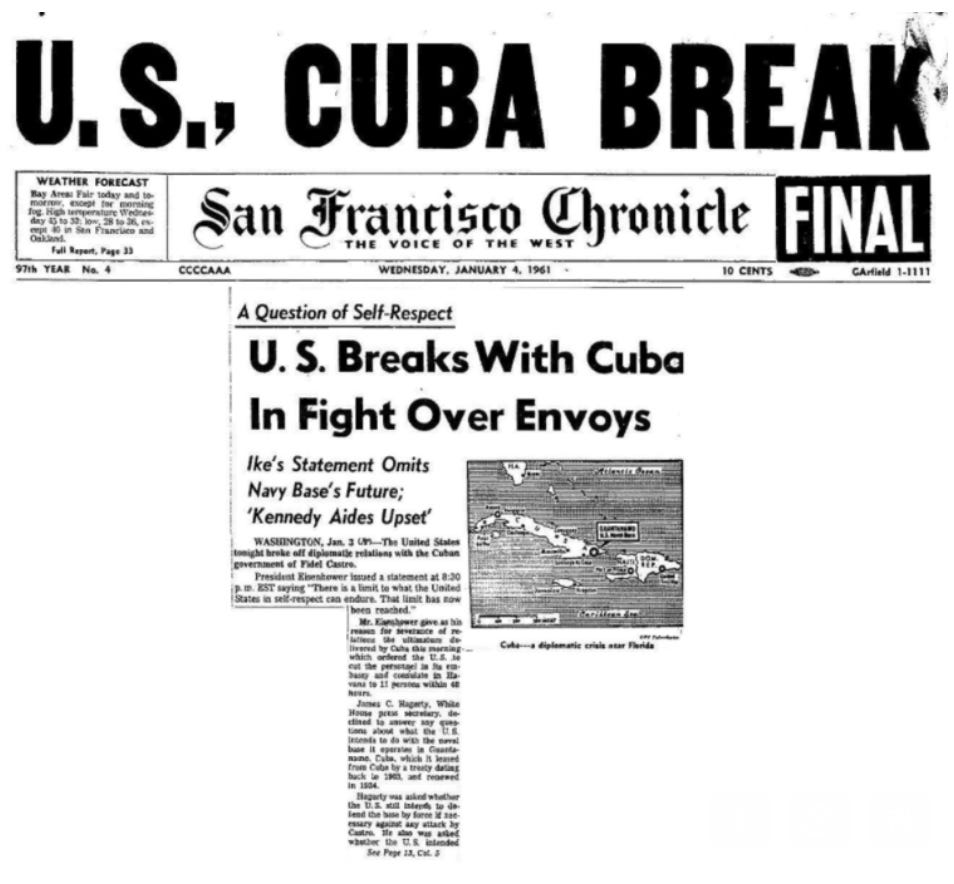
Tens of thousands of Cubans were lined up outside of the U.S. embassy in Havana seeking visas to flee the communist dictatorship, and this became a source of embarrassment for the communist regime. Fidel Castro communicated with the Eisenhower Administration on January 3, 1961 and demanded the expulsion of 67 U.S. diplomats, within 48 hours, reducing their number to 11, the same number at the Cuban embassy in Washington DC. The Americans had over 50,000 visa applications to process when the ultimatum was delivered.
On January 3, 1961 at 8:30 p.m. EST President Eisenhower issued a statement stating: “There is a limit to what the United States in self respect can endure. That limit has now been reached,” and severed diplomatic relations with Cuba.
President John Fitzgerald Kennedy took office on January 20, 1961.
A year later, between January 22, 1962 to January 31, 1962 the Kennedy Administration successfully lobbied the Foreign Ministers of the member countries of the Organization of American States (OAS) to expel Cuba from the regional body.
The U.S. embargo was expanded and formalized on February 3, 1962.
On February 3, 1962 President John F. Kennedy declared in Proclamation 3447 an “Embargo on All Trade with Cuba” in which it was “resolved that the present Government of Cuba is incompatible with the principles and objectives of the Inter-American system; and, in light of the subversive offensive of Sino-Soviet Communism with which the Government of Cuba is publicly aligned, urged the member states to take those steps that they may consider appropriate for their individual and collective self-defense.”
On July 26, 1964 the OAS imposed multilateral sanctions on Cuba and member states broke relations with Havana throughout the Western Hemisphere, with Mexico the only country maintaining relations with Havana at the time.
To understand the US embargo, it is important to understand the internal blockade
Afro-Cuban American scholar, Amalia Dache, an associate professor in the Higher Education Division at the University of Pennsylvania who “engages in research within contested urban geographies, including Havana, Cuba; Cape Town, South Africa; and Ferguson, Missouri” explained in July 21, 2021 the reality of the US embargo and the Castro regime’s internal blockade.
“No. It’s very hard for me to say that as someone who still has family living in Cuba. But lifting the embargo would not magically improve their lives. Here’s why: To understand the US embargo, it’s important to know about the internal blockade the Cuban government imposes on its own people. For example, the US embargo does still allow for food and medicine sales to Cuba. The Cuban government buys $100 million worth of chicken from producers in the United States annually. It sells that chicken to the Cuban people at a marked-up rate, sometimes at double the cost, and uses the profit to fund the regime. Other countries trade freely with Cuba, but because the government is heavily involved, the internal blockade keeps those profits from reaching the Cuban people. Poor neighborhoods — Afro Cuban neighborhoods — get the worst of the shortages. The police and military get money for new cars and surveillance technology.”
The regime in Cuba is also a kleptocracy, pleading poverty while hoarding 18 billion dollars in the coffers of the Cuban military’s conglomerate GAESA.
Improved relations with Havana must be conditioned to specific reforms.
1. A general amnesty for all political prisoners like the one Fidel Castro received in 1955 from the Batista government;
2. That the Castro government withdraw its troops and military leadership from Nicaragua, Ukraine, and Venezuela.
3. That Havana eliminate all restrictions and regime profiteering on the distribution of humanitarian aid from international organizations and from Cuban Americans to needy Cubans in the island.
It is also important not to confuse engagement with the Cuban people with collaborating with the dictatorship that oppresses them.
This is why the Center for a Free Cuba is joining with voices from the island to call for an international embargo on weapons and repressive equipment being sent or sold to Cuba.
Now is the time for the international community to side with Cubans, not their oppressors. Vote no on the resolution offered by the Cuban dictatorship to the UN General Assembly on the U.S. embargo on Cuba, and send them a message that business as usual is over.
Sources available here.