

Milan Kundera, the Czech writer, in his 1999 novel The Book of Laughter and Forgetting observed that “the struggle of man against power is the struggle of memory against forgetting.” Memory provides context to unfolding events today, and helps to render informed judgements. On the centenary of Fidel Castro’s birth it is a good moment to revisit some of his observations on the U.S. embargo on Cuba.
Thirty years of Fidel Castro claiming U.S sanctions were unimportant
Havana claims that the U.S. economic embargo on Cuba over the past sixty six years has cost the Cuban dictatorship $1.499 trillion, but that was not what the regime, and their maximum leader, said during the first 30 years of the Cuban dictatorship. Here are some of the statements made by Fidel Castro between the 1964 through 2000 related to the economic embargo.
“We are going to have, within ten years, a milk production higher than the Netherlands and a cheese production higher than France. That is the great goal that we propose to achieve. By that date we think that the amount of 30 million liters of milk will be exceeded. So there will be to export … you can imagine.” said Fidel Castro, in an interview with Eddy Martin from the official Hoy newspaper on March 2, 1964.
“The great battle of the eggs has been won. From now on the people will be able to have sixty million eggs each month,” said Fidel Castro in a speech on January 2, 1965.
“In 1970 the Island will have 5,000 experts in the cattle industry and around 8 million cows and calves that will be good milk producers” …. “There will be so much milk that the Bay of Havana will be able to be filled with milk,” said Fidel Castro in his December 1966 speech during the Assembly of the Federation of Cuban Women, a mass organization of the dictatorship.
Fidel Castro, speaking at the First Congress of the Communist Party of Cuba in December 1975 bragged about the unimportance of economic sanctions saying,“at first (the United States) their cancellations were quite annoying … but when luckily, we did not depend on them for anything, neither in trade, nor in supplies, nor in anything. If we are already victorious now, after victory, what can they threaten us with? With canceling what … what? ”
“The United States has less and less to offer Cuba. If we could export our products to the United States, we would have to start making plans for new production lines … because everything that we produce now and everything that we are going to produce in the next five years has already been sold to other markets. We should deprive other socialist countries of these products in order to sell them to the United States. But the socialist countries pay us much better prices and have much better relations with us than we have with the United States. There is a popular saying that goes: ‘Don’t trade a cow for a goat.’” said Fidel Castro in his interview with Playboy published in April 1985
“Cuba will not buy an aspirin or a grain of rice. They have put a lot of restrictions (on the permission to sell food and medicine) that make it humiliating for the country, but also make it impossible in practice,” said Fidel Castro, in front of the United States Interests Office, in Havana, Cuba on October 18, 2000.
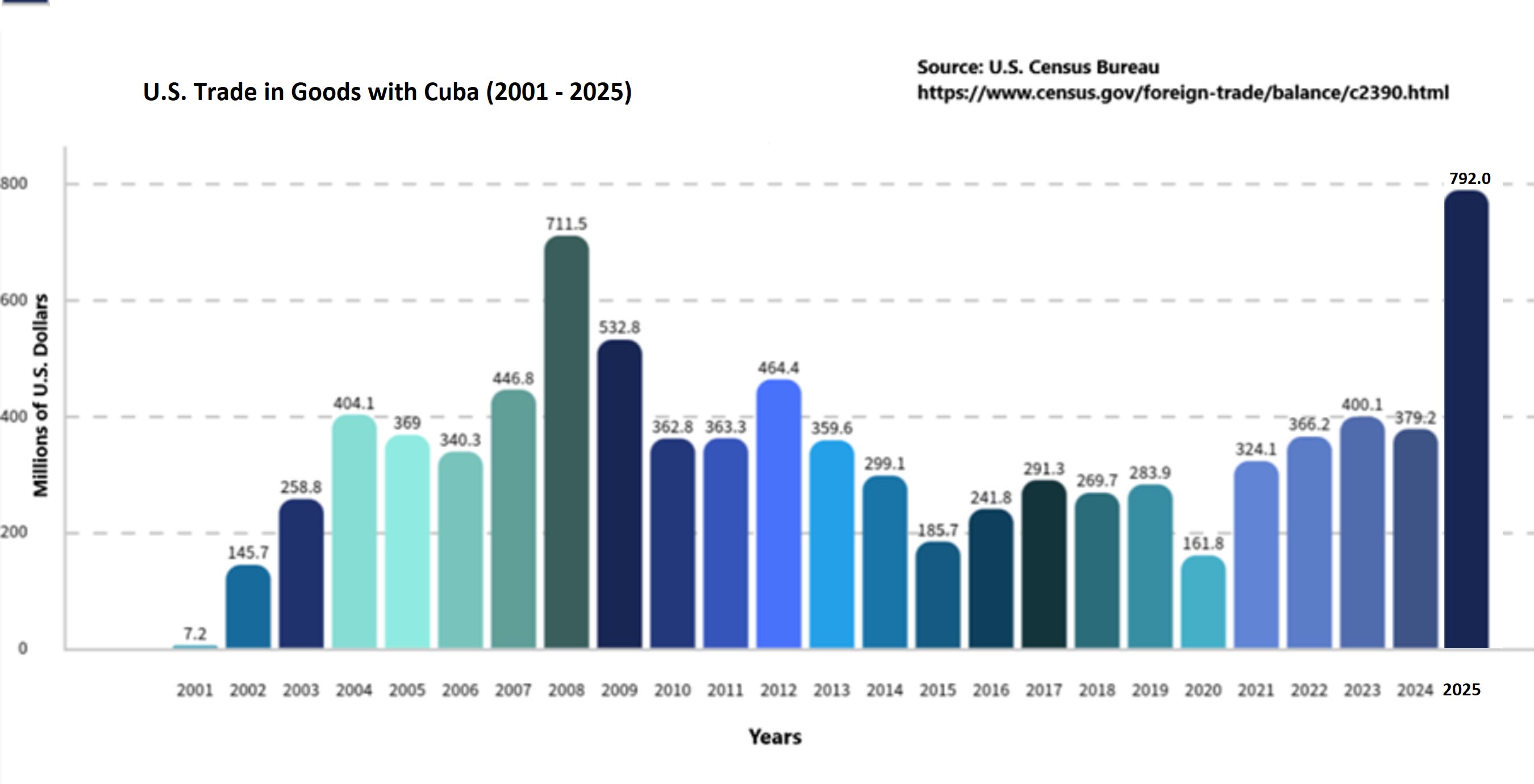
Fidel Castro had a point. Cuba’s existential economic crisis was and is not due to the embargo. The Castro regime would go on to purchase billions in American agricultural products between 2000 and the present, but to do so they defaulted on what they owed to others. The peak year of trade between Cuba and the United States was in 2025, the last full year on record of the the Donald J. Trump Administration.
Nevertheless food security has not improved, nor was it better during the Biden Administration.
The 2024 bread shortage in Cuba
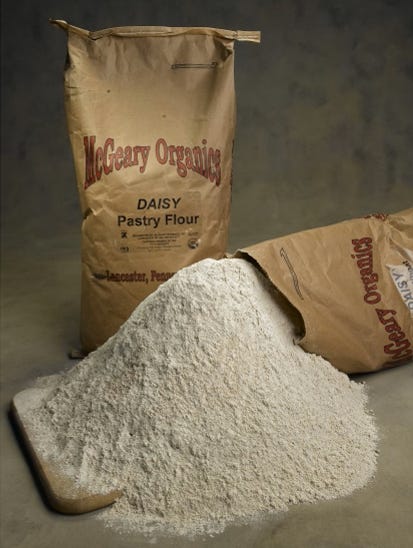
Havana on March 4, 2024 confirmed it had sought help from the World Food Program to guarantee the supply of subsidized powdered milk for children. On February 24, 2024 Emerio Gonzalez Lorenzo, president of the “Grupo Empresarial de la Industria Alimentaria” (GEIA) [Food Industry Business Group] which is under the Cuban government’s “Ministerio de la Industria Alimenticia” (MINAL) [ Ministry of the Food Industry ] announced that “there is little bread in Cuba due to a lack of flour,” and that this situation would continue until the end of March 2024.
Official press channels made no mention of the “25,000 tons of wheat donated by the Russian government that arrived in mid-January” 2024 which “exceeds the 20,000 tons that, authorities assured [on February 24th], are necessary to cover the rationed daily bread rolls for a month. If this is the case, the shipment of Russian wheat should have been enough to supply the stores for the remainder of this month and the next”, reported 14ymedio.
The suspension of bread from the ration book in 2024, announced by Havana, was not due to U.S. sanctions as the Cuban dictatorship claims.
The shortage of bread is due to the fact that of the five mills to turn wheat to flour in Cuba, only the one currently operational is in Cienfuegos. There is no shortage of wheat, but of flour due to the Cuban government’s monopoly over the means of production, and its inefficiency, and corruption.
This is compounded by the regime’s track record of giving priority for supplies of flour for tourists in luxury hotels, compared to the hunger of Cuban families who also suffer blackouts, piles of garbage on corners with infestations of mice, mosquitoes and cockroaches, plus sewage leaks and lack of drinking water.
The US State Department in its 2025 fact sheet on the “Provision of Humanitarian Assistance to Cuba” clearly states: “While the embargo remains in place, the U.S. government prioritizes support for the Cuban people, and U.S. law and regulations include exemptions and authorizations relating to exports of food, medicine, and other humanitarian goods to Cuba, as well as disaster response.”
Trade in mainly agricultural products with Cuba amounted to $400 million in 2023, in contrast to only $241.8 million during the last full year of the Obama Administration’s thaw with Havana in 2016.
Debunking myths about the Cuban Embargo
Press accounts of the U.S. Embargo on Cuba do not mention how it saved American taxpayers from joining their Canadian, Chinese, European, and Russian counterparts in paying off bad debt by the Cuban government. Nor do they discuss the circumstances that drove the United States to impose an embargo on Havana.
U.S. policy towards Cuba has not been static since January 1, 1959 but has been changing and driven by various interests, including U.S. national interests. There is a lot of disinformation about how the U.S. Embargo was first imposed on Cuba, and how and why the U.S. broke diplomatic relations with Havana. Here is a brief breakdown of what happened between January 1, 1959 and January 3, 1961.
How the U.S. embargo on Cuba came to be imposed
Fidel Castro overthrew the Fulgencio Batista regime on January 1, 1959 following a U.S. arms embargo being imposed on the military dictator in the spring of 1958. The United States had actively pressured Batista to leave office since 1958. On January 7, 1959 the United States recognized the new Cuban government ushered in by the Castro brothers. It took just seven days to recognize the new regime.
In comparison it had taken the United States 17 days to recognize the government of Fulgencio Batista following his March 10, 1952 coup. The United States had not been consulted ahead of time about Batista’s plans and this led to the delay in recognition.
In April 1959 Fidel Castro visited the United States on an eleven day trip that concluded with a three hour meeting with Vice President Richard Nixon on April 19, 1959.
Within nine months of U.S. recognition of the revolutionary government in Cuba the new regime began targeting American interests on the island, allying itself with the Soviet Union, the People’s Republic of China, and plotting the overthrow of several Latin American governments.
It is important to revisit how the embargo was first imposed, and why it remains relevant today.
Fidel Castro visits Caracas on January 23, 1959 and meets with Venezuelan President Romulo Betancourt, a social democrat, “to enlist cooperation and financial backing for ‘the master plan against the gringos.’”
On March 3, 1959 the Castro regime expropriates properties belonging to the International Telephone and Telegraph Company, and took over its affiliate, the Cuban Telephone Company.
On May 17, 1959 the government expropriated farm lands over 1,000 acres and banned land ownership by foreigners.
Havana beginning in 1959 sent armed expeditions to Panama, Haiti, Nicaragua, Venezuela and the Dominican Republic to overthrow their governments.
On February 6, 1960 talks began publicly between the U.S.S.R and Fidel Castro. The Soviet Union agreed to buy five million tons of sugar over five years. They also agreed to support Cuba with oil, grain, and credit.
On July 6, 1960 the Castro regime passed a nationalization law authorizing nationalization of U.S.- owned property through expropriation. Texaco, Esso, and Shell oil refineries were taken.
The Eisenhower Administration reduced the sugar quote for Cuba on July 6, 1960 by 700 tons.
In September 1960 the Cuban government diplomatically recognized the People’s Republic of China.
The Eisenhower State Department in response to the above actions imposed the first trade embargo on Cuba on October 19, 1960, and it “covered all U.S. exports to Cuba except for medicine and some foods.” This did not alter Havana’s behavior.
On November 19, 1960 Ernesto “Che” Guevara heading a Cuban delegation in Beijing met with Mao Zedong between 4:20pm and 6:30pm and discussed revolutionary objectives in Latin America.
On December 16, 1960 the sugar quota by the United States for Cuba was reduced to zero.
The last straw: When the limit was reached, and diplomatic relations severed
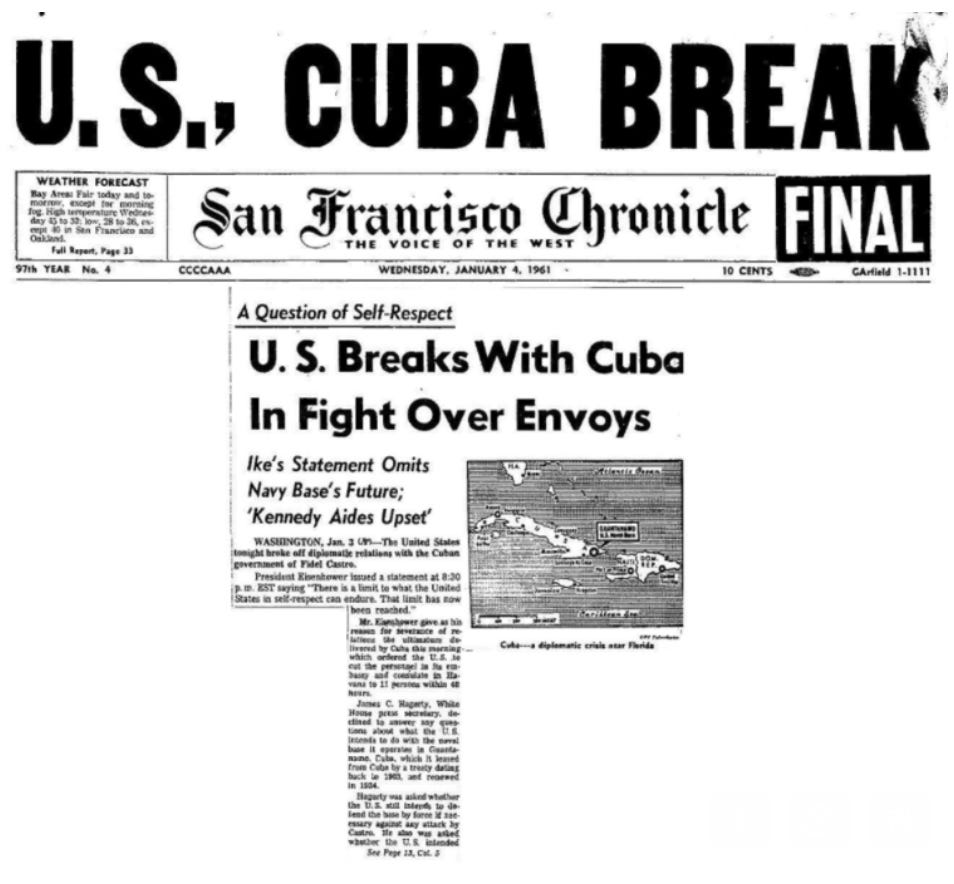
Tens of thousands of Cubans were lined up outside of the U.S. embassy in Havana seeking visas to flee the communist dictatorship, and this became a source of embarrassment for the communist regime. Fidel Castro communicated with the Eisenhower Administration on January 3, 1961 and demanded the expulsion of 67 U.S. diplomats, within 48 hours, reducing their number to 11, the same number at the Cuban embassy in Washington DC. The Americans had over 50,000 visa applications to process when the ultimatum was delivered.
On January 3, 1961 at 8:30 p.m. EST President Eisenhower issued a statement stating: “There is a limit to what the United States in self respect can endure. That limit has now been reached,” and severed diplomatic relations with Cuba.
President John Fitzgerald Kennedy took office on January 20, 1961.
A year later, between January 22, 1962 to January 31, 1962 the Kennedy Administration successfully lobbied the Foreign Ministers of the member countries of the Organization of American States (OAS) to expel Cuba from the regional body.
The multilateral economic embargo (1962)
The U.S. embargo was expanded and formalized on February 3, 1962.
On February 3, 1962 President John F. Kennedy declared in Proclamation 3447 an “Embargo on All Trade with Cuba” in which it was “resolved that the present Government of Cuba is incompatible with the principles and objectives of the Inter-American system; and, in light of the subversive offensive of Sino-Soviet Communism with which the Government of Cuba is publicly aligned, urged the member states to take those steps that they may consider appropriate for their individual and collective self-defense.”
On July 26, 1964 the OAS imposed multilateral sanctions on Cuba and member states broke relations with Havana throughout the Western Hemisphere, with Mexico the only country maintaining relations with Havana at the time.
Warming of relations between Washington and Havana did not begin until the tail end of the Nixon Administration, following the start of detente with China and the Soviet Union. Nixon traveled to China in February 1972 and met with Mao Zedong dropping opposition to Beijing’s entry to the United Nations, and in May 1972 Nixon traveled to the Soviet Union and met with Leonid Breshnev and supported a nuclear arms agreement. National Security Advisor Henry Kissinger had laid the groundwork for both meetings, and the overall detente.
Shifting from multilateral to unilateral sanctions on Havana to improve relations, and how it failed
In 1973 Henry Kissinger assumed the position of Secretary of State while also retaining his position as National Security Advisor in the Nixon Administration, and began to explore the possibility of a detente with Fidel Castro. Nestor T. Carbonell, in his important 2020 book Why Cuba Matters: New Threats in America’s Backyard, describes what happened next.
“Cuba remained a controversial political issue in the United States, so Kissinger guardedly looked for an intermediary to make initial contacts with the Castro regime (as President Kennedy had done with journalist Lisa Howard following the Missile Crisis). The choice this time was Frank Mankiewicz, a freelance journalist and former spokesman for Robert Kennedy who had recently shot a documentary on Cuba for CBS and was returning to Havana to interview Castro…” According to Kissinger, Nixon was not enthusiastic about the emissary, but he went along with a message to Castro along these lines: “America in principle was prepared to improve relations [with Cuba] on the basis of reciprocal measures agreed in confidential discussions … and was willing to show our goodwill by making symbolic first moves.”
Fidel Castro responded to the outreach with Mankiewicz with a box of Cuban cigars for Kissinger and a message expressing interest in “relaxing tensions” – the definition of détente. In the meantime, Watergate led to the early departure of Nixon from the White House on August 9, 1974 and Gerald Ford, his vice president, replacing him. [However, Kissinger continued with both positions through November 3, 1975, and as Secretary of State until the end of the Ford Administration on January 20, 1977.]
“A preliminary meeting was held on January 11, 1975, at a cafeteria in New York, by Deputy Undersecretary of State Lawrence Eagleburger with two Castro representatives: Ramón Sánchez Parodi, a senior official of the Cuban Communist Party, and Néstor García, first secretary of Cuba’s UN mission. This was followed by a substantive discussion on July 9 at the Pierre Hotel in Manhattan, led by Assistant Secretary of State for Inter-American Affairs William Rogers, who covered some of the steps approved by Secretary of State Henry Kissinger to relax tensions, phase out the embargo, and normalize relations. […]
“Eager to clinch a deal with Castro, the Ford administration offered several inducements to the Cuban ruler without any quid pro quo. First, the United States voted in favor of the July 29, 1975, OAS resolution, effectively ending the multilateral diplomatic and economic sanctions against the Castro regime. Then on August 19, President Ford eased the US embargo, allowing foreign subsidiaries of US companies to trade with Cuba, dropping foreign aid penalties on countries trading with the island, and permitting ships en route to Cuba to refuel in the United States.”
The hoped for “easing of tensions” did not occur, but instead the Ford Administration ended up with egg on its face.
Castro’s response was to send thousands of Cuban troops to Africa, first to Angola. According to the [Department of State Bulletin Volume 89 – February 1989] On September 23, 1975 “Secretary of State Henry Kissinger declared that events in Angola had taken a ‘distressing turn’ and that the United States was ‘most alarmed at the interference of extracontinental powers,’ i.e., the Soviet Union and Cuba.” [ Cubans had been there since at least March 1975]
All pretense that Cuba only had an advisory role was dropped on November 5, 1975, [Department of State Bulletin Volume 89 – February 1989] when thousands of Cuban troops were fighting in Angola; by February 1976, the number had increased to an estimated 14,000.” Cuban involvement in Angola would continue until 1991.
Kissinger was so angered by the Cuban intervention in Angola, and the failure of detente that he entertained the idea of air strikes on Cuba.
This pattern of opening up to the Castro regime with unilateral concessions, legitimizing it internationally, providing it more resources, followed by negative consequences was established by Henry Kissinger during the Nixon and Ford Administrations and would be repeated on greater scale by the Carter, Clinton, Obama, and Biden Administrations over the next five decades.
To understand the US embargo, it is important to understand the internal blockade
Afro-Cuban American scholar, Amalia Dache, an associate professor in the Higher Education Division at the University of Pennsylvania who “engages in research within contested urban geographies, including Havana, Cuba; Cape Town, South Africa; and Ferguson, Missouri” explained in July 21, 2021 the reality of the US embargo and the Castro regime’s internal blockade.
“No. It’s very hard for me to say that as someone who still has family living in Cuba. But lifting the embargo would not magically improve their lives. Here’s why: To understand the US embargo, it’s important to know about the internal blockade the Cuban government imposes on its own people. For example, the US embargo does still allow for food and medicine sales to Cuba. The Cuban government buys $100 million worth of chicken from producers in the United States annually. It sells that chicken to the Cuban people at a marked-up rate, sometimes at double the cost, and uses the profit to fund the regime. Other countries trade freely with Cuba, but because the government is heavily involved, the internal blockade keeps those profits from reaching the Cuban people. Poor neighborhoods — Afro Cuban neighborhoods — get the worst of the shortages. The police and military get money for new cars and surveillance technology.”
The dictatorship in Cuba is also a kleptocracy, pleading poverty while hoarding 18 billion dollars in the coffers of the Cuban military’s conglomerate GAESA. The profits don’t reach the average Cuban, but regime elites, beginning with Fidel Castro, and today with his great grand nephew, Raúl Guillermo Rodríguez Castro, lived and live lives of great wealth while 94% of Cubans live in extreme poverty.
Poverty in Cuba is a function of the dictatorship, not U.S. sanctions, but Europeans and Canadians have been subsidizing regime elites with their taxpayers’ money- sustaining the government immiserating Cubans.
Esta “En 1970, la isla contará con 5.000 expertos en la industria ganadera y alrededor de 8 millones de vacas y terneros que serán buenos productores de leche”…todas los discursos y promesas de Fidel Castro, fueron la trampa o cebo que utilizó para subvertir el hemisferio, sí la leche 'subió' un poco, pero no por las vacas, sino por el agua que le hechó en las pasteurizadoras, a los niños dentro de Cuba a los 7 años de edad ya no les asignaron leche. Etc etc etc etc