

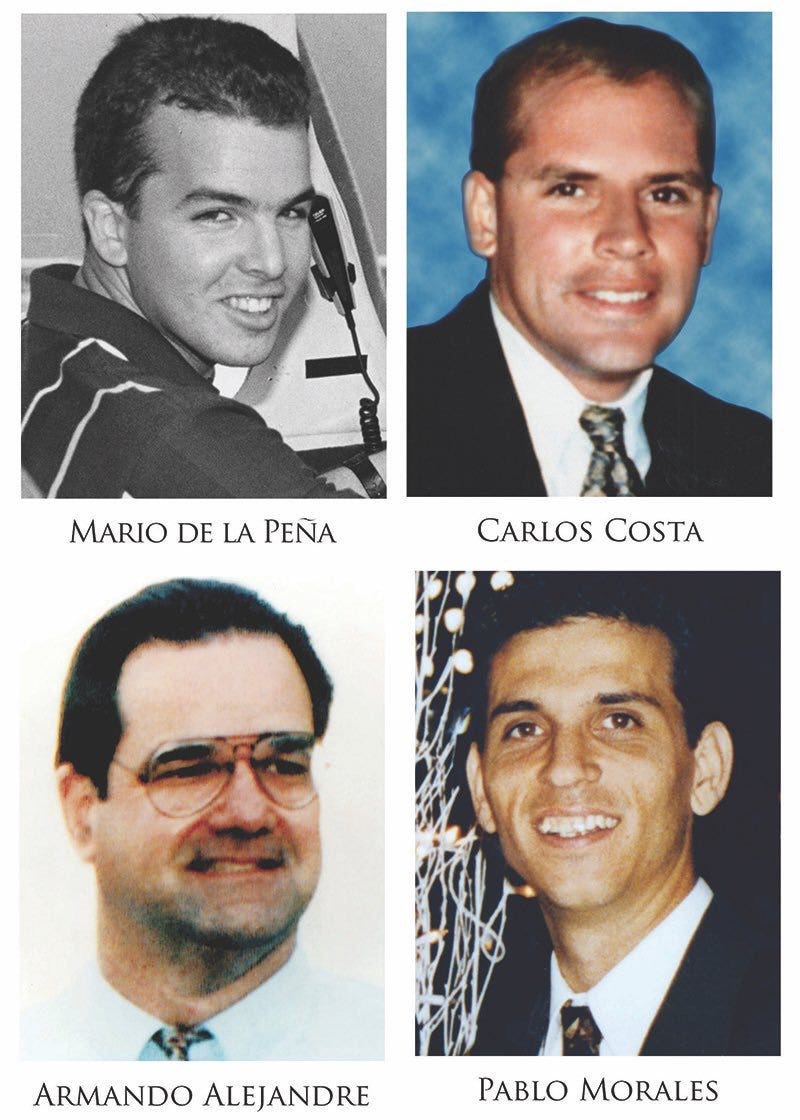
Havana’s WASP spy network infiltrated the United States to gather information on military installations and personnel, sow division among Cuban exiles, locate places to store weapons and explosives, and terrorize then assassinate a CIA agent living in Florida with a mail bomb. They helped kill Carlos Costa, Armando Alejandre Jr., Mario de la Peña, and Pablo Morales in the February 24, 1996 Brothers to the Rescue shoot down.
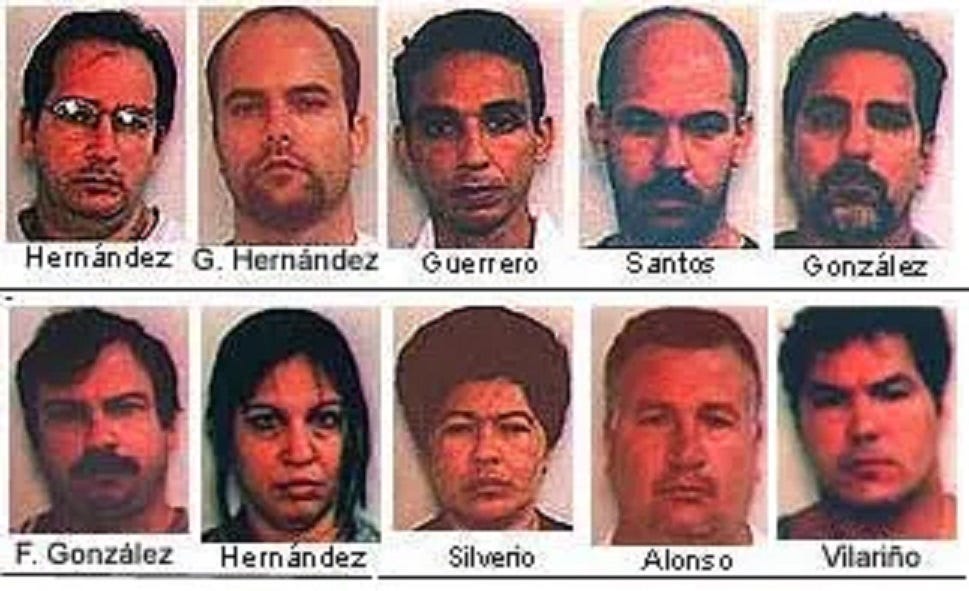
On September 12, 1998, the FBI dismantled the largest Cuban spy ring ever discovered in the United States. Ten people were charged with being Cuban spies.
The ten members of the WASP network captured were: GERARDO HERNANDEZ, 31 (alias Manuel Viramontes), the spymaster; FERNANDO GONZALEZ, 33 (alias Ruben Campa), and RAMON LABANINO, 30 (alias Luis Medina), another Cuban intelligence officer.
The remaining seven were mid-level or junior agents who passed their reports to one of these three senior agents. Included were ANTONIO GUERRERO, 39, who observed aircraft landings at the Boca Chica Naval Air Station from his job as a sheet-metal worker there; ALEJANDRO ALONSO, 39, a boat pilot; and RENE GONZALEZ, 42, a skilled aircraft pilot and the only U.S. born among these seven. Both joined the Democracy Movement to report on its nonviolent activities against the Castro regime.
Two married couples, all American citizens, also worked in the spy network: NILO and LINDA HERNANDEZ, ages 44 and 41 respectively, and JOSEPH and AMARYLIS SANTOS, both 39.
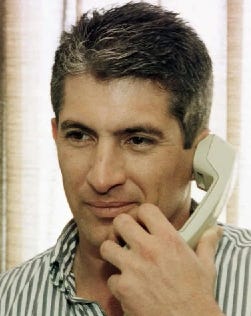
JUAN PABLO ROQUE, an eleventh spy also charged and linked to the 1996 Brothers to the Rescue shoot down, had already fled to Cuba, a day before Cuban MiGs launched missiles destroying two planes, and killing four. Three others identified as John Does were also charged. He was also an FBI informant who gave false information to federal agents.
Five defendants, Alejandro Alonzo, Nilo Hernandez and Linda Hernandez, Joseph Santos and Amarylis Santos, accepted plea bargains and cooperated with prosecutors. These five Cuban spies provided information about the other five.
The other five spies eventually went on trial. The U.S. State Department on July 20, 2026 released the report, “Cuba: The Capital of 21st Century Communism” which has a section on this spy network that also described the evidence presented.
“The evidence presented at trial included more than a thousand pages of decoded communications recovered from nearly a thousand encrypted computer disks seized from network members’ apartments in South Florida.”
The trial revealed that the Cuban spy ring was engaged in both espionage, terrorism, and facilitated the extrajudicial killing of three U.S. citizens and a U.S. resident in the February 24, 1996 Brothers to the Rescue shoot down.
The regime in Cuba has spent 28 years attempting to airbrush this past as part of its global disinformation campaign. They’ve even enlisted the entertainment industry in this endeavor. NETFLIX settled a lawsuit out of court in January 2024 that accused the streaming giant of distorting key facts about Brothers to the Rescue leader Jose Basulto and his organization at the direction of the Cuban dictatorship.
Left out of the NETFLIX propaganda piece was how the spy network’s head Gerardo Hernandez was convicted of espionage and murder conspiracy and sentenced to two life sentences. Hernandez was convicted of conspiracy to murder, not “anti-terrorism.”
The Cuban government’s effective espionage apparatus has successfully infiltrated government, academic, and media institutions in the United States to steal information, shape policy, and manipulate public opinion. They have recruited Americans, used Cuban diplomats, and infiltrated illegal agents to advance these goals. They have also conducted active measures in the United States that got Americans killed.
However, they do make mistakes and U.S. counterintelligence discovered some of them. The WASP network was one of the biggest.
Victor Manuel Rocha was discovered in 2023. Rocha served on the National Security Council and as U.S. Ambassador to Bolivia, among other important posts, —all the while secretly operating as a Cuban agent. He was sentenced to 15 years in prison on April 12, 2024.
However, one can assume that others continue to operate. The terrorist threat continues, and Cuba is a state sponsor of terrorism.
State terrorism
On May 17, 2012 the Subcommittee on the Western Hemisphere in the U.S. Congress’s Committee on Foreign Affairs held a hearing on “Cuba’s Global Network of Terrorism, Intelligence, and Warfare.” Among the experts who spoke at the hearing was Mr. Christopher Simmons, founding editor of Cuba Confidential, an online blog and source for news on Cuban espionage worldwide. He is an international authority on the Cuban Intelligence Service and retired from the Defense Intelligence Agency with over 23 years of experience as a counterintelligence officer, and played an important role in the capture of Ana Belen Montes.
Simmons ended his presentation outlining and summarizing the high profile act of state terrorism that killed four Cuban Americans in an operation conducted on orders from highest levels of the Castro regime.
“Last, but not least, of the highlighted issues, I’d like to address Operation Scorpion which was addressed earlier as a shootdown of Brothers to the Rescue. While this mission on February 24, 1996 predates the other information I discussed, it is important because this act of terrorism involves highest levels of the Castro regime. On February 24, 1996, Cuban MiGs shot down two U.S. search and rescue aircraft in international waters. Code named Operation Scorpion, it was led by General Eduardo Delgado Rodriguez, the current head of Cuban intelligence. It was personally approved by Fidel Castro and supported by Raul Castro, the current President of Cuba. Four Americans were murdered in this act of terrorism.”
The Cuban WASP network case and its involvement in the 1996 Brothers to the Rescue shoot down conspiracy, plotting to terrorize and murder a retired U.S. intelligence agent, and infiltrating U.S. military facilities underscores once again the terrorist nature of the Cuban dictatorship on the international scene, including the United States.
It is also important to recognize the Cuban dictatorship’s global reach, and the network it created in 1966 at the Tricontinental Conference in Havana, Cuba with the establishment of the Organization for the Solidarity of the Peoples of Asia, Africa and Latin America (OSPAAL).
OSPAAL would support revolutionary and terrorist groups in Europe, Africa, the Americas, and Asia until 2019 with the stated objective to struggle against imperialism, but in practice it was only against democracies. Cuban officials claimed that it had “fulfilled its foundational mission” of supporting Third World decolonization struggles and promoting unity around just causes.
The English Wikipedia entry on OSPAAAL—notes that the independently founded Tricontinental Institute for Social Research “seeks to continue the heritage of the Tricontinental conference and the organization.”
The Institute (launched around 2017–2018, inspired by the 1966 Conference) was welcomed by OSPAAAL leadership. It has publicly paid homage to the organization, and continues related work.
À quarter+ of à century has passed ànd communist Cuba now is a clear ànd present danger to the U.S.
Why has the US not cleaned house in Cuba?
Borrón y cuenta nueva!
🙏🙏🇨🇺🙏🙏
Los Castro hicieron de Cuba un estado terrorista con vínculos globales, sus ambiciones de destruir a los Estados Unidos 🇺🇸 y todas las Democracias del hemisferio están todavía en su agenda.